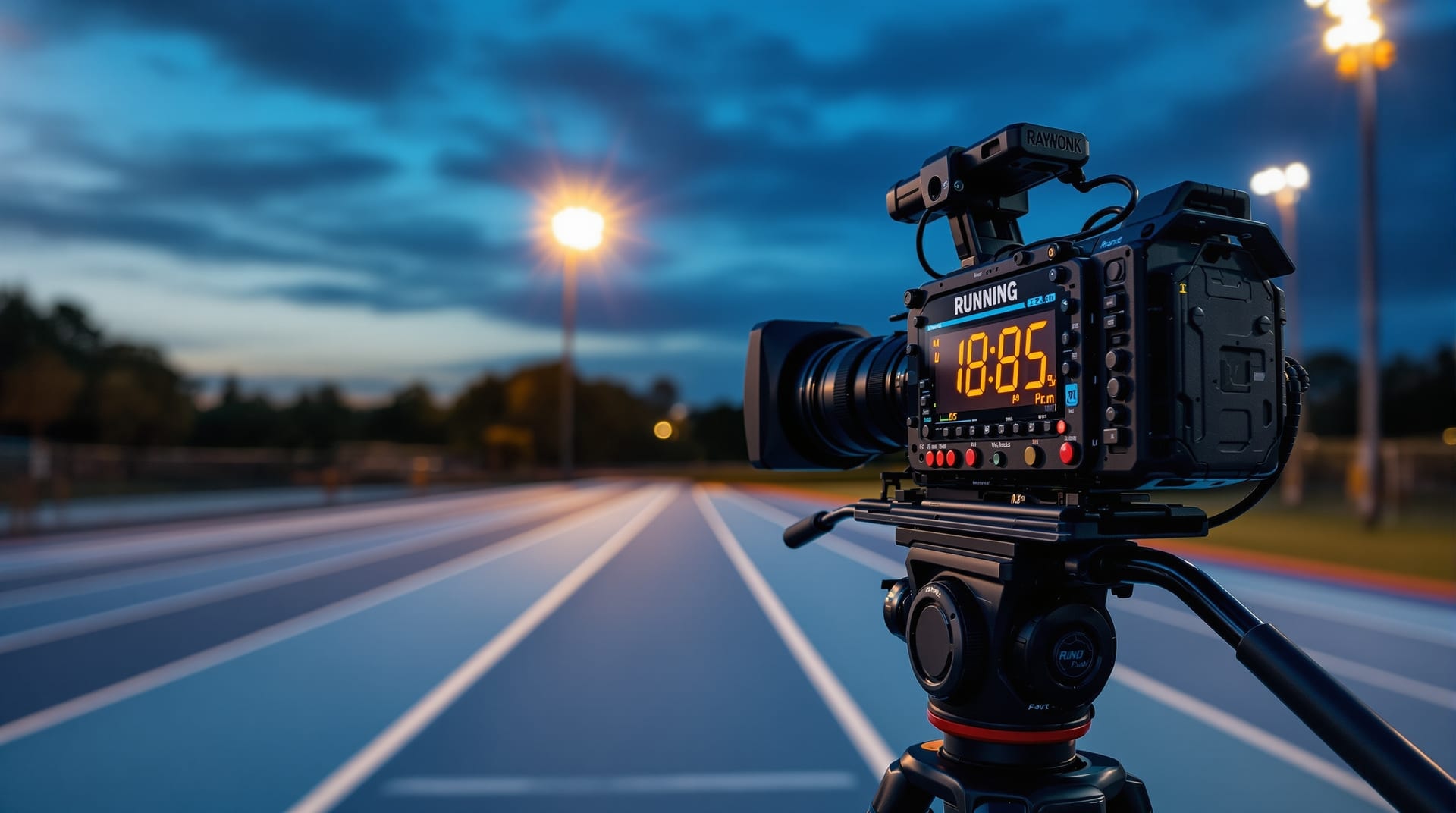
Video occupies a particular place in endurance coaching: it is the only tool that shows an athlete what they are actually doing, as opposed to what they believe they are doing. That gap is largest in swimming, where the athlete can see nothing, and smallest in cycling, where the position is fixed — but it exists in every discipline, and it is the reason video became a standard part of technique assessment long before it was convenient.
It is also the tool most easily misused. A slow-motion clip of an athlete is compelling and can make any deviation look like a fault. What follows is about using it well.
Frame rate before everything else
The single most common technical failure in amateur video analysis is filming too slowly. The events that matter are brief: a runner's foot is on the ground for roughly two tenths of a second, and a swimmer's catch is set and lost inside a similar window. Filmed at a standard rate, the loading peak may fall between frames entirely, and the resulting slow-motion playback is a smooth interpolation of things that were never recorded.
A high frame rate — the slow-motion mode on a modern phone is generally adequate — matters far more than resolution. It also requires light: high frame rates need short exposures, so indoor pools and evening tracks produce dark, smeared footage unless lighting is deliberately arranged.
Camera position and consistency
A camera should be perpendicular to the plane of the movement being examined and at the height of the joint of interest. A camera angled downward introduces perspective distortion that will be read as a fault: a knee filmed from above appears to collapse inward whether it does or not.
Consistency between sessions matters more than perfection within one. The whole point of a follow-up assessment is comparison, and a comparison between two clips filmed from different distances, heights and angles is uninterpretable. Recording the camera set-up — distance, height, lens, frame rate — is as much a part of the protocol as the measurements. The discipline-specific view lists are set out in running gait analysis, swim stroke assessment and bike fit and pedalling analysis.
Voice-over review
The traditional deliverable from a video assessment is a narrated review: the footage played back at reduced speed with commentary, freeze-frames at the key positions, and a demonstration of the intended correction alongside the athlete's own action. The format survives because it solves a real problem — an athlete watching silent footage of themselves generally cannot tell which of the many things they can see is the one that matters.
Three conventions make a review useful rather than demoralising:
- Say what is working first. Athletes watching themselves in slow motion are primed to see faults everywhere, and an unanchored review encourages a scattergun attempt to fix all of them.
- Name one or two targets, no more. A review listing eight findings produces no change at all.
- Show the target, do not only describe it. A demonstration of the intended action side by side with the athlete's own is worth several paragraphs of description.
What the evidence says about feedback
Video is a form of augmented feedback, and the motor-learning literature is clear that not all feedback is equally useful. Work comparing combined versus singular verbal or haptic feedback shows that acquisition — how quickly a movement is performed correctly under instruction — and retention — whether it persists afterwards — do not respond identically. Feedback that produces the fastest immediate improvement is not always the feedback that lasts.
There is a further, more useful finding. Research on how to improve movement execution in a change-of-direction task found that corrections the athlete arrives at themselves, given the right constraints, are retained better than corrections handed to them. Applied to a video review, this argues for asking the athlete what they notice before telling them, and for choosing a cue that lets them find the movement rather than one that describes a position to hold.
The corollary matters too: feedback given on every repetition can create dependence on it. An athlete who is only correct while being watched has not learnt anything durable.
Remote analysis
Filming and reviewing can be separated in time and place, which was historically how athletes at a distance from a testing facility were assessed at all: the athlete recorded themselves, sent the footage, and received a narrated review covering one, two or all three disciplines. The method is unchanged today except that the logistics are trivial.
Its constraint is that the review can only be as good as the footage. A remote assessment therefore depends on the filming instructions being followed exactly — the specified angles, distances, frame rate and speeds. Footage shot casually from wherever the phone happened to be resting produces a review full of hedged statements, because the analyst cannot distinguish a real asymmetry from a camera that was not square to the athlete.
What video cannot tell you
Video shows kinematics — positions and their changes over time. It does not show force, and it does not show effort. A movement that looks smooth may be produced at a metabolic cost that makes it a poor choice; a movement that looks awkward may be the athlete's most economical option given their particular proportions and strength.
This is the main reason a video assessment is normally paired with a physiological test rather than read in isolation, and the reason technique findings should always be checked against the athlete's history: an asymmetry that has been present for a decade without consequence is a characteristic, not a fault.