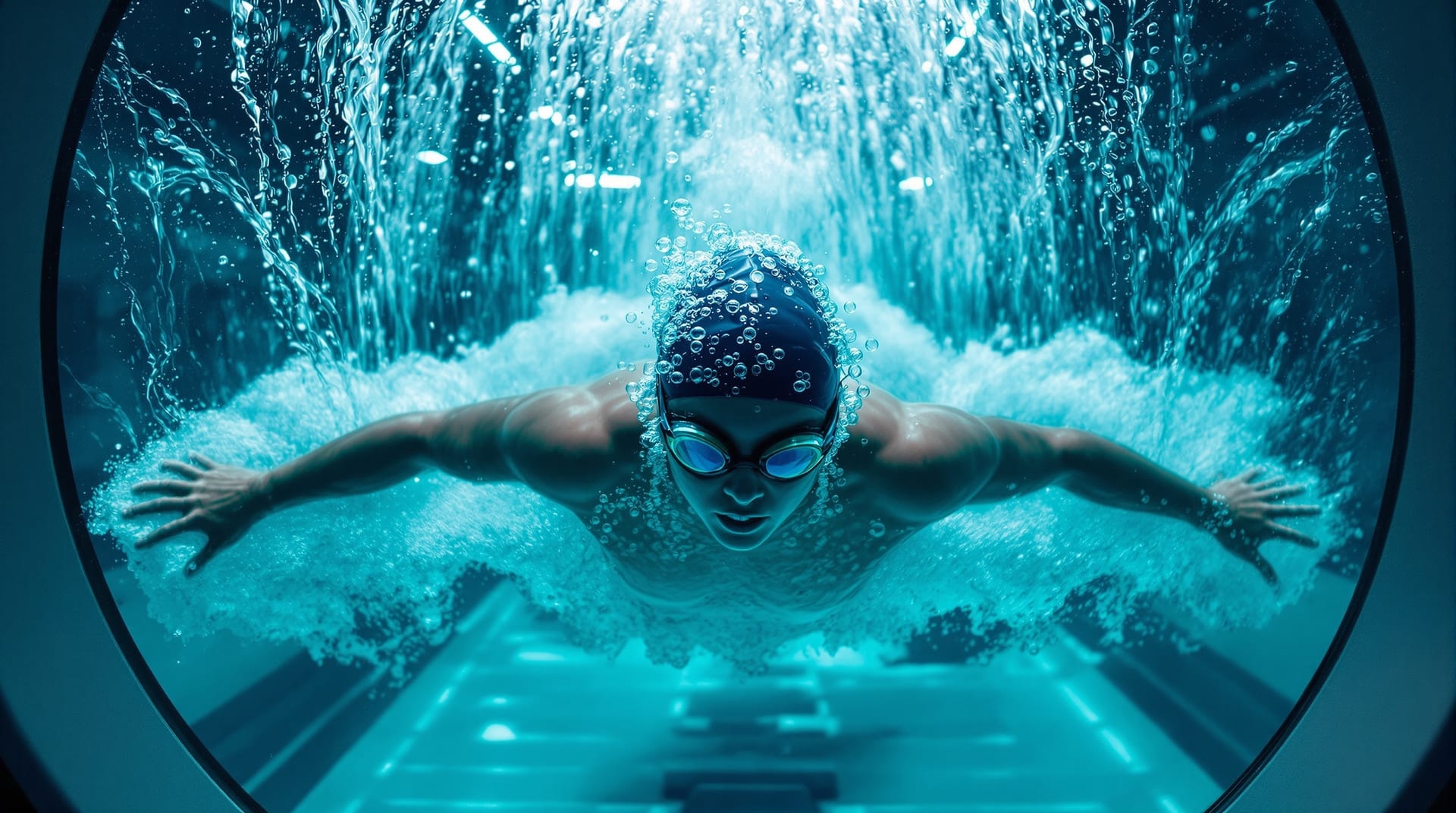
Swimming is the discipline in which an athlete's perception of what they are doing correlates least with what they are actually doing. The body is horizontal, the head is mostly underwater, and there is no mirror. A stroke that feels long and powerful may be slipping badly; a stroke that feels rushed may be the athlete's best. Assessment exists to close that gap.
This page describes how structured swim assessment works — the equipment, the protocol, what is measured and what a sensible re-test interval looks like. It is descriptive: it explains what an athlete is looking at in an assessment report, not a service that can be arranged here.
The swim flume
A swim flume is an indoor swimming treadmill: a tank in which water is driven past a stationary swimmer at a controlled speed. Purpose-built flumes of the kind used for endurance assessment are deep enough to swim naturally in — of the order of seven feet — and generate variable currents comfortably above four miles per hour, which is faster than most athletes can hold.
The flume's value is that it removes the two things that make pool observation difficult. The swimmer stays in one place, so a camera can be fixed and the same frame captured every cycle; and the speed is set externally rather than chosen by the athlete, so the stroke can be observed at a defined pace rather than at whatever pace the athlete drifted into.
Its limitation matters too. A flume has no walls, no turns and no push-offs, and the flow is more uniform than open water or a busy lane. It is an instrument for looking at a stroke, not a substitute for swimming.
What is filmed, and from where
A complete stroke assessment uses several viewpoints, because each fault is visible from only some of them.
- Underwater, from the side — the most informative single view. It shows the catch, elbow position through the pull, the depth of the hand path, and whether the hips ride high or low.
- Underwater, from the front — shows crossover on entry, hand path relative to the midline, and asymmetry between the two arms.
- Underwater, from below — shows the kick, its amplitude and whether it originates at the hip or the knee.
- Above water, from the side — shows head position, the breathing action, and whether the breath is taken by rotating or by lifting.
- Above water, from behind — shows recovery path, shoulder height and any snaking of the body line.
Frame rate matters more than resolution. The catch is set and lost inside a fraction of a second, and a low frame rate simply misses it. The general considerations for filming and reviewing movement are covered in video as a coaching instrument.
The measurements that matter
An assessment produces numbers as well as pictures, and a small set of them carries most of the information.
- Stroke count per length or per unit distance, always paired with the time, so that efficiency and speed can be separated.
- Stroke rate in cycles per minute, which together with stroke count describes how the athlete produces a given speed.
- Phase durations — how long the catch, pull, push and recovery occupy within the cycle, and whether they are symmetrical left to right.
- Body-line angle — the inclination from shoulder to hip to ankle, which is the direct measure of the drag problem.
- Kick amplitude and origin — whether the legs are contributing or being dragged.
What these are worth predicting is a separate question. Work on determinants of 1500-metre front-crawl performance in triathletes examines which physiological and technical variables actually relate to swim performance in this population, and is a useful corrective to assessments that measure everything measurable and rank nothing.
Benchmark testing alongside the stroke work
A technique assessment is usually paired with a physiological benchmark — a graded swim in which speed is stepped up and effort, heart rate and, where available, blood lactate are recorded. The point is not the absolute numbers but the reference: a repeatable test whose result can be compared against itself months later. The general logic of these tests, and their limitations, is set out in judging training intensity.
Re-testing, and why twelve weeks
The conventional interval between a stroke assessment and its follow-up is about twelve weeks, and the reasoning is straightforward. A motor pattern that has been established over years does not change in a fortnight, and testing too soon measures the athlete's ability to remember an instruction rather than a change in habit. Twelve weeks is long enough for a deliberate change to become the default under mild fatigue, and short enough that the athlete has not spent a season grooving something that is not working.
The follow-up should repeat the original protocol exactly: same views, same speeds, same measurements. An assessment that changes its own method between rounds cannot tell the athlete anything. Between rounds, the work is ordinary — the drills and the deliberate swimming described in swimming technique, done frequently and while fresh. Further material for adult swimmers is published in the U.S. Masters Swimming articles and videos library.