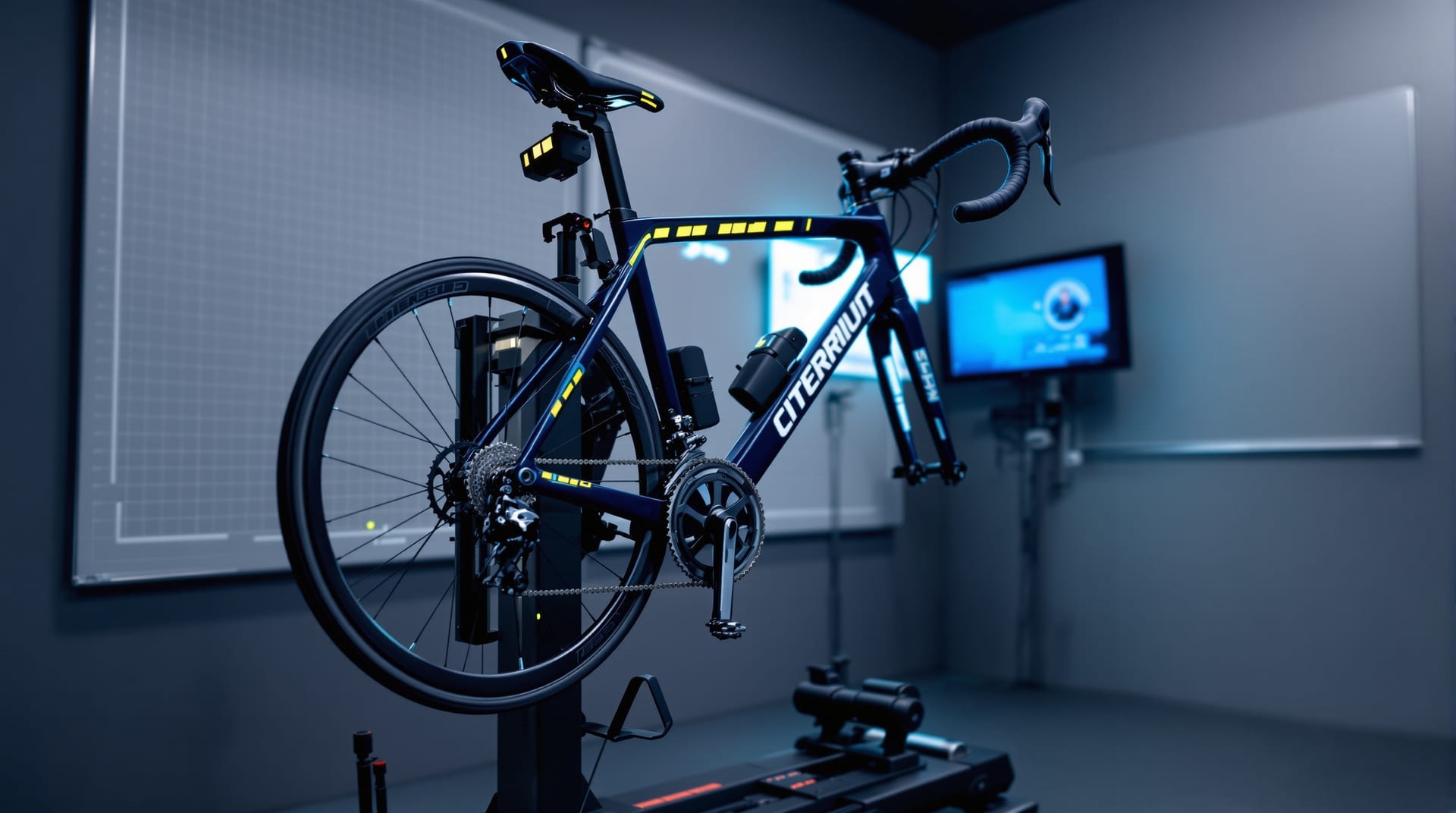
A cycling assessment answers two related questions. The first is geometric: does the bicycle place the rider's joints in a range where they can produce force comfortably for the duration the rider needs? The second is dynamic: given that position, what is the rider actually doing with the pedals, and what does it cost them?
Both are worth doing and they are not the same exercise. A perfectly fitted position ridden with a poor intensity discipline is still a slow ride; a superb pedal stroke in a position that cannot be held for three hours is worth nothing at hour four.
Goniometric measurement
The traditional fitting method measures joint angles directly with a goniometer at defined points in the pedal cycle — knee angle at bottom dead centre, hip angle at top, elbow angle in the riding position, ankle angle through the stroke. Modern systems capture the same angles continuously from reflective markers and video, which adds the ability to see how the angles change under load and fatigue rather than only in a static pose.
The measurement itself is not the point. The point is that joint angle is the variable that connects a bicycle dimension to a physiological consequence, and it is repeatable in a way that "feels about right" is not.
Saddle height and setback
Saddle height sets the knee's range of motion, and both extremes carry a cost. Too low and the knee stays flexed under high load through the whole downstroke, which loads the patellofemoral joint and shortens the effective stroke. Too high and the hips rock as the leg reaches for the bottom of the stroke, the ankle over-extends, and the hamstring and posterior knee take a repeated stretch.
The review of effects of bicycle saddle height on knee injury risk and cycling performance examines the ranges these considerations produce and how they differ between an injury-avoidance objective and a performance objective. It is worth noting that the two do not always recommend the same height, which is why a fit for a rider returning from a knee problem is a different exercise from a fit for a rider chasing a time.
Setback — the fore-aft position of the saddle — determines where the foot sits relative to the pedal spindle at the top of the stroke and therefore how work is shared between the quadriceps and the hip extensors. Moving the saddle forward is not a substitute for moving it up; the two change different things, and doing both at once makes the result uninterpretable.
Reach, drop and the aerodynamic compromise
The front of the bicycle sets trunk angle. Lowering the front reduces frontal area, which above roughly 25 km/h is where most resistance comes from, but it closes the hip angle, and beyond a point the closed hip limits the rider's ability to drive the leg at the top of the stroke. The limit is individual and depends mostly on hip mobility.
The fitting question is therefore not "how low can this rider go" but "how low can this rider go and still hold it for the duration of the event without losing power or shifting position". This is why a fit for a one-hour time trial and a fit for a long-course triathlon produce different bicycles for the same athlete.
What the rider experiences from these changes is measurable rather than a matter of opinion. Work on the effect of bike fit on comfort, fatigue and pain tracks exactly those outcomes across a fitting intervention.
Cleat position
The foot's fixed attachment to the pedal is the most constrained joint on the bicycle and the one most often ignored. Fore-aft cleat position changes the leverage of the calf and the load on the Achilles; rotational position determines whether the knee is allowed to track along its natural path or is twisted into one; lateral position affects hip and knee alignment in the frontal plane.
Cleat changes have consequences out of proportion to their size — a few millimetres alters loading noticeably — so they are made one at a time, in small increments, with riding between them.
Power, spin scan and what the data show
Instrumented cranks or pedals can report not only total power but how force is distributed around the crank circle, sometimes displayed as a polar plot of force by angle. Read carefully, this shows a genuine fault: a leg that rests on the rising pedal produces negative torque through the upstroke, and the other leg pays for it.
Read carelessly, the same display invites a fruitless project of trying to make the polar plot round. The most efficient riders do not produce evenly distributed force, and chasing an even distribution generally makes riders slower and more tired, as noted in cycling technique and position. The useful targets are eliminating genuine negative torque and reducing gross left-right asymmetry, not achieving a circle.
Graded testing and the follow-up
A cycling assessment is usually paired with a graded exercise test on the fitted position, stepping power up in stages while heart rate, perceived effort and, where used, blood lactate are recorded. That gives the intensity anchors the rider will train against, and it must be repeated in the same position to remain comparable — a change of fit invalidates the old anchors. The reasoning behind those anchors is covered in judging training intensity, and the filming considerations in video as a coaching instrument.
A twelve-week follow-up is the conventional interval, for the same reason it is used in swimming: it allows a position change to be absorbed and a pedalling habit to settle before it is measured again.