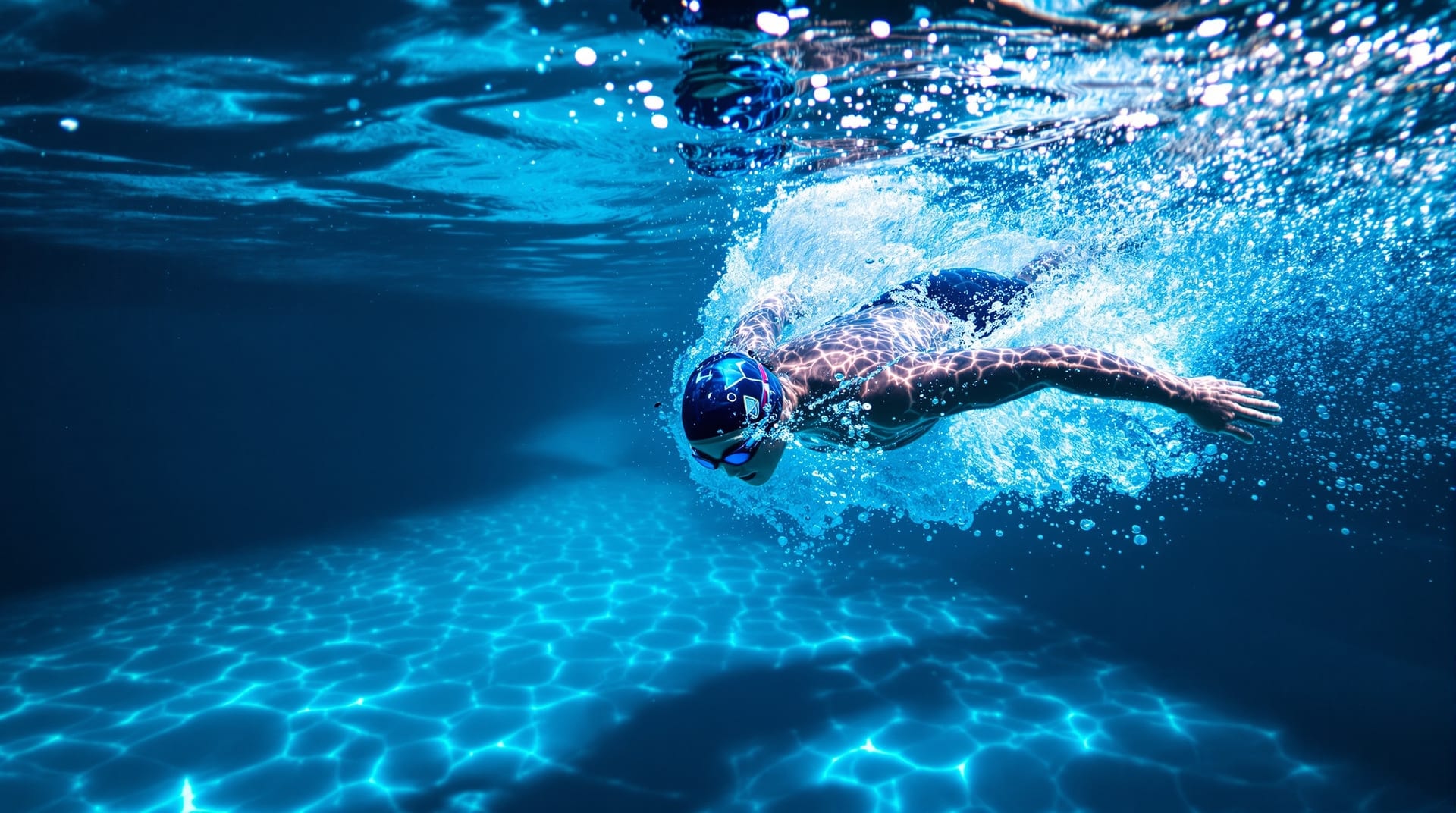
Swimming rewards technique more than any other endurance discipline, and the reason is physical rather than cultural. Water is roughly eight hundred times denser than air, and the resistance it offers rises with the square of velocity. An athlete who reduces drag by a modest fraction gains more than one who increases power by the same fraction — and unlike power, drag reduction costs nothing in energy.
This is why an adult who comes to endurance sport from running or cycling can be extremely fit and still swim slowly. The fitness is real; it is being spent on pushing water out of the way. The corrective is not more swimming. It is better swimming, repeated often enough to become the default.
Body position comes before everything
The single largest source of drag for most adult swimmers is a low hip and leg position that turns the body into an inclined plane. Every stroke then has to lift as well as propel. The usual causes are a head held too high, a breath taken by lifting rather than rotating, and a weak or absent kick that lets the legs sink.
The fix is postural rather than muscular. Looking down rather than forward drops the head and raises the hips. Breathing by rotating the whole body — so that one goggle stays in the water — avoids the lift that pushes the hips down. A light, continuous kick from the hip rather than the knee holds the legs in the shadow of the body rather than dragging them through undisturbed water.
The stroke cycle
The front crawl arm action divides into recognisable phases: entry and extension, catch, pull, push, and recovery. Their proportions are not arbitrary. Analysis of phase durations in the front crawl stroke shows a self-similar structure across the cycle, and departures from it are usually where an inefficient stroke can be identified.
The phase most commonly missing in adult swimmers is the catch — the moment when the hand and forearm are set against the water before the pull begins. Without it the arm sweeps through a slipping stroke that moves a great deal of water and very little swimmer. Setting the catch means allowing the elbow to stay high while the forearm angles down, so that the hand and forearm act together as a single paddle.
The second common fault is a recovery that crosses the midline on entry, which forces the body to snake and adds drag at exactly the moment the opposite arm is trying to hold a line.
Distance per stroke and stroke rate
Swimming speed is stroke length multiplied by stroke rate, and the two trade against each other. Counting strokes per length is the cheapest diagnostic in the sport: it takes no equipment, is repeatable, and tracks technical change directly.
The useful measurement is not stroke count alone but stroke count together with the time for the length. A swimmer who reduces stroke count while holding the same time has become more efficient. A swimmer who reduces stroke count and gets slower has simply started gliding, which is a different and less useful habit.
Most adult endurance swimmers over-glide rather than over-rate. The pause at full extension feels efficient and is not: velocity decays fastest at the point of least propulsion, and the swimmer has to accelerate the whole mass again on every stroke.
Drills, and what they are for
A drill is a temporary constraint that makes one element of the stroke unavoidable. It is not a workout and it does not transfer automatically — a drill only helps if the athlete then swims normally and deliberately keeps the feature the drill isolated.
- Single-arm swimming — isolates the catch and pull on one side, and exposes an asymmetry between them.
- Catch-up variants — slow the cycle enough that the extension and entry can be felt, at the cost of exaggerating the glide; use sparingly for that reason.
- Sculling — teaches the feel of pressure on the forearm, which is the sensation the catch depends on.
- Kick on the side — trains the rotated body position that breathing has to work within.
- Fist swimming — removes the hand so the forearm has to do the work, which makes a slipping catch obvious.
Drills belong early in a session, while the athlete is fresh. Technique work done at the end of a hard swim rehearses a tired stroke.
Open water changes the problem
Open water removes the wall, the black line and the lane, and adds chop, other swimmers, a wetsuit and the need to navigate. Each of these has a technical consequence.
A wetsuit raises the legs, which flatters poor body position and means a swimmer who relies on it can be markedly slower without it. Sighting — lifting the eyes forward every few strokes — costs body position each time, so it is done as a brief crocodile-eyes lift folded into the breathing rotation rather than as a separate head-up movement. Chop favours a slightly higher stroke rate and a slightly shorter reach, because a long glide in disturbed water simply decays.
Where dryland fits
Swimming is limited more often by shoulder mobility and by weakness in the muscles that stabilise the shoulder blade than by aerobic fitness. A short, regular block of dryland strength and mobility work protects a discipline in which overuse injury is common and almost always insidious. For an objective picture of what a stroke is actually doing, rather than what it feels like, see flume and video stroke assessment. Adult-athlete technique and workout material is published by U.S. Masters Swimming.