Every training plan specifies how hard the athlete should work, and every athlete then has to decide, in the moment, whether they are working that hard. The gap between those two things is where most training plans quietly fail. An athlete whose easy sessions are moderate and whose hard sessions are also moderate is following a plan on paper and doing something else in practice.
This page describes the instruments used to close that gap — perceived effort, heart rate, pace and power, blood lactate, and readiness measures — and, as importantly, what each of them gets wrong.
Perceived effort
Rating of perceived exertion is the oldest instrument and the most underrated. It requires nothing, works in every discipline, responds instantly to changes in effort, and — unlike heart rate — automatically accounts for heat, altitude, fatigue and illness, because those things genuinely make a given pace harder.
Its weakness is calibration. An athlete who has never worked genuinely hard has no top of scale, and one who habitually trains at a middling intensity tends to compress the whole range into the middle. The remedy is to anchor the scale against reference sessions: the effort of a comfortable long ride, the effort of a maximal ten-minute test.
The most useful practical version is the talk test. If full sentences are comfortable, the session is easy; if only short phrases are possible, it is moderate; if speech is reduced to single words, it is hard. This maps loosely onto the physiological thresholds below and costs nothing.
Heart rate, and its failure modes
Heart rate is the most widely used objective measure, and it is a good one for steady aerobic work. It also has well-documented limitations that catch athletes out constantly. The review of heart rate monitoring: applications and limitations collects them; the ones that matter day to day are these.
- It lags. Heart rate takes a minute or more to reflect a change in effort, which makes it close to useless for intervals shorter than a few minutes.
- Cardiac drift. During prolonged exercise, heart rate rises at constant work as fluid is lost and core temperature climbs. An athlete holding heart rate constant on a long ride is progressively slowing down.
- It moves with conditions. Heat, dehydration, altitude, caffeine, illness and poor sleep all shift heart rate at a given effort, sometimes by ten beats or more.
- Maximum is individual and cannot be estimated. Age-based formulae carry an error of plus or minus ten to twelve beats, which is enough to invalidate every zone derived from them.
- It differs between sports. Maximum heart rate in swimming is typically lower than in running, and zones from one sport should never be applied to another.
The practical consequence is that heart rate zones should be built from a measured threshold rather than an estimated maximum, and re-measured a few times a year.
Thresholds, and what they mean
Training zones are usually anchored to one or two thresholds: an aerobic threshold, at which blood lactate first rises above resting values, and a second threshold, above which lactate accumulates faster than it can be cleared and effort becomes unsustainable.
The terminology surrounding these points is a genuine mess — lactate threshold, anaerobic threshold, onset of blood lactate accumulation, maximal lactate steady state, critical power and functional threshold power all describe overlapping but non-identical concepts, determined by different protocols, and they do not give the same number. The critical review lactate threshold concepts: how valid are they? works through what these measurements do and do not represent, and is worth reading by anyone about to make training decisions from a threshold figure.
Three things are worth carrying away. Lactate is a fuel and a signal, not a waste product and not the cause of soreness. A threshold is a moving point on a continuum, not a switch. And whichever definition is used, the number is only useful as a reference to itself — the value of a threshold test is comparison with the same test done three months earlier, using the same protocol.
The graded exercise test
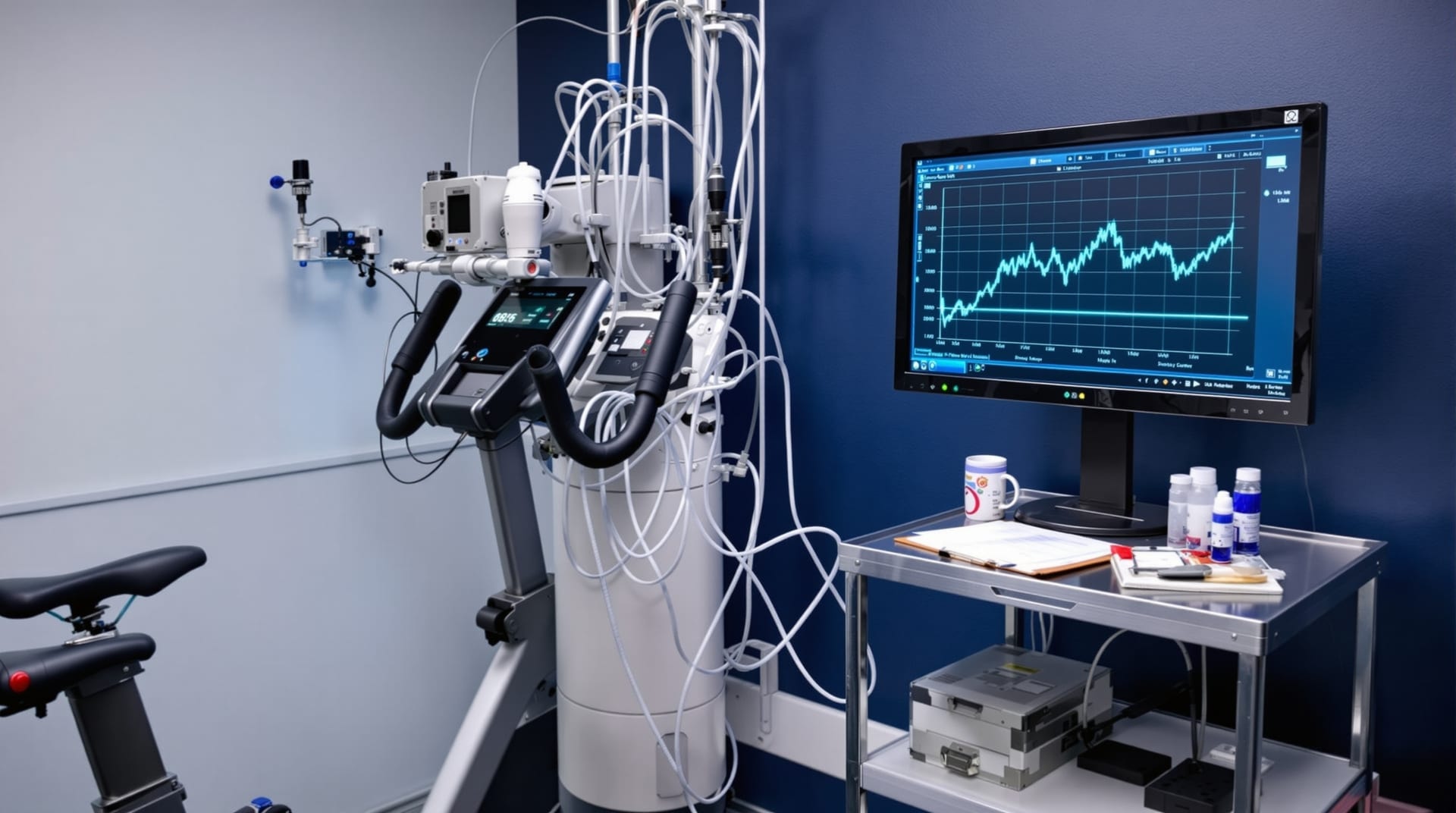
The standard method for establishing these anchors is a graded exercise test: work rate is increased in steps of a few minutes each, and heart rate, perceived effort and, where available, blood lactate from a fingertip or earlobe sample are recorded at the end of each stage. The result is a set of curves from which thresholds can be identified and zones assigned.
For most athletes a laboratory test is unnecessary. A well-executed field test — a maximal effort of twenty to thirty minutes in the relevant discipline, with average heart rate and pace or power recorded — produces anchors that are entirely adequate, and the protocol can be repeated by the athlete alone.
Whichever is used, the test must be repeated identically to remain comparable, and it must be repeated in the discipline it will be applied to. A change of bike position invalidates cycling anchors, as noted in bike fit and pedalling analysis.
Pace and power
Pace and power measure output rather than response, which makes them the precise instruments for short intervals where heart rate cannot keep up. Power on the bike is the cleanest measure available in any endurance sport, because it is unaffected by wind, gradient or fatigue.
Their limitation is the mirror image of heart rate's: output tells you nothing about cost. Holding a target power while ill, dehydrated or exhausted is possible and expensive. This is why the sensible practice is to combine an output measure with perceived effort, and to treat a large mismatch between them — target pace felt much harder than usual — as information rather than as something to push through.
Readiness and heart rate variability
A separate class of measurement asks not how hard a session is but whether the athlete should do it today. Resting heart rate, sleep, subjective wellbeing and heart rate variability all belong here. Practices and applications of heart rate variability monitoring in endurance athletes covers what the measure can support and how it is used in practice.
Two cautions apply. Day-to-day variability is large, so single readings are close to meaningless and trends over a week or more are what carry signal. And these measures are best used to identify a genuine outlier — an unusually poor week — rather than to micro-adjust every session, which produces an athlete who never trains hard because some number was slightly low. Their role in spotting accumulated fatigue is discussed in recovery and restoration.
Getting the distribution right is the point
All of this instrumentation exists to serve one decision: making the easy sessions genuinely easy and the hard sessions genuinely hard. That is the change with the largest effect on most athletes' training, and it is achievable with nothing more sophisticated than the talk test. The plan those intensities fit into is described in building a training program.
Nothing on this page is medical advice. Graded testing to maximum effort and blood sampling are procedures that belong in appropriately supervised settings, and any athlete with a cardiovascular history, symptoms during exercise, or a medical condition affecting exercise tolerance should be assessed by a qualified clinician before testing to maximum.